
Mixing
Vocal sibilance vs harshness: diagnose before de-essing
Tell sharp consonants from hard vowels and processing artifacts, then use a treatment that targets the actual problem.
Sibilance is the noise-like edge of consonants such as s and sh. Harshness can instead be a hard vowel, a shout, a resonance, or distortion. Their frequency ranges can overlap, so diagnose the event before choosing a de-esser.
By Spectraforge Audio3 min read
Published · Updated
Guide review: Captum Records and AS Mastering. AI-assisted writing and source checks. How these guides are made.
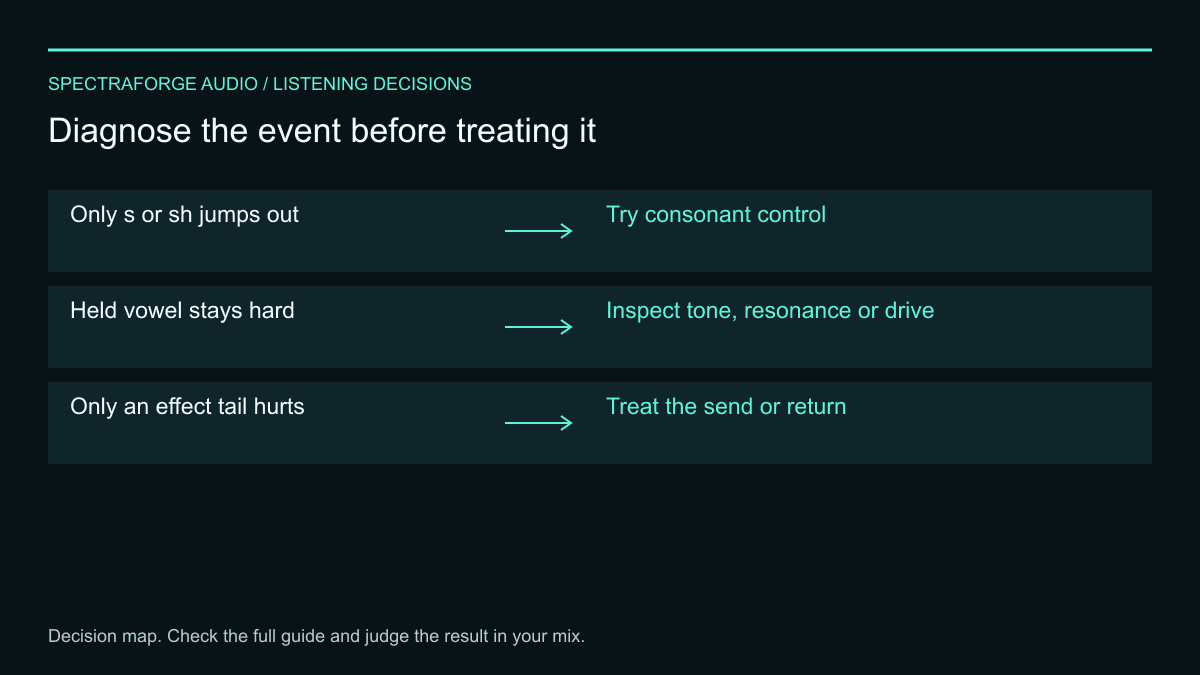
Separate consonants from the rest of the phrase
Loop a phrase with a strong consonant and a held vowel. Mark exactly what makes you want to turn the vocal down, then use this first-pass decision:
| What you hear | First move | Check |
|---|---|---|
| Only s or sh jumps out | Try consonant control | Keep the full word and diction intact |
| Held vowel stays hard | Inspect tone, resonance or drive | Compare a small EQ move or local edit |
| Only an effect tail hurts | Treat the send or return | Confirm where the feed leaves the chain |
- Only s or sh leaps forward: start with consonant control.
- The vowel stays hard after the consonant ends: investigate tone, resonance, or drive.
- Only the reverb or repeat is painful: treat its feed or return.
- The edge appears after one insert: reduce that insert's contribution before adding a repair stage.
Find where the edge enters the chain
Listen to the recording with later effects bypassed, then restore the chain one stage at a time at comparable levels. Compression can change the relative prominence of quieter syllables; bright EQ and harmonic processing can make an existing edge more noticeable. A distorted recording and an overdriven insert require different decisions from a clean but sibilant performance.
For a hypothetical vocal, suppose the raw esse is acceptable but becomes detached after a high shelf. Reduce that shelf first. If the phrase then feels too dull overall, use a smaller lift with selective consonant control. If the edge appears only after saturation, compare less drive before adding another corrective plugin after it.
Tune de-essing from the actual voice
Use detector audition briefly to find the consonant energy. Set a limited reduction range, then adjust detection until difficult consonants trigger it and comfortable words mostly pass. Return to full-band listening to judge pronunciation.
Pro-DS documents two separate choices: Single Vocal versus Allround detection, and wide-band versus split-band processing. The latter determines whether detection lowers the whole signal or its high-frequency band. Do not assume every de-esser distinguishes vowels from consonants in the same way. Compare the complete word in each mode; a lower reduction reading is not a better result by itself.
Treat sustained hardness separately
If the vowel itself is hard, try a small static EQ move when the tone is consistently excessive, or a dynamic band when only forceful notes need restraint. Locate the area in context and keep the bandwidth broad enough to solve the audible problem. Avoid turning a boosted solo sweep into a catalogue of every resonance the voice contains.
For one isolated shout, clip gain or automation may be more predictable than a processor acting across the whole song. Listen across the edit for continuity. If reducing one region makes the singer hollow, you may be targeting a useful part of their character rather than the source of fatigue. Back off and revisit level, drive, and masking.
Keep diction and effects intact
Briefly solo the reverb and delay returns. If their consonant tails are the problem, compare a filtered return, a lower send on the offending syllable, or a feed taken after de-essing. Confirm the send tap point before expecting an insert to change that feed.
Check for a lisp, a dip that continues into the next vowel, or an effect tail that changes color unnaturally. Reduce the treatment if those appear. If an overloaded or unsuitable take is available to rerecord, compare that option; otherwise preserve believable diction rather than removing every trace of edge.
Technical references
Listening exercises are proposed practice routines. Worked examples illustrate the stated setup; they are not reports of our listening tests. Editorial process and corrections.