
Mixing
Dynamic EQ vs de-esser: which should you use?
Choose between a level-dependent EQ band and a consonant-focused detector using the sound and timing of the problem.
Start with a de-esser for consonants that jump out of an otherwise suitable vocal. Start with dynamic EQ for an intermittent tonal region, such as a hard held note or a ringing instrument. Use static EQ when the imbalance is continuous, and local edits when only a few events need help.
By Spectraforge Audio3 min read
Published · Updated
Guide review: Captum Records and AS Mastering. AI-assisted writing and source checks. How these guides are made.
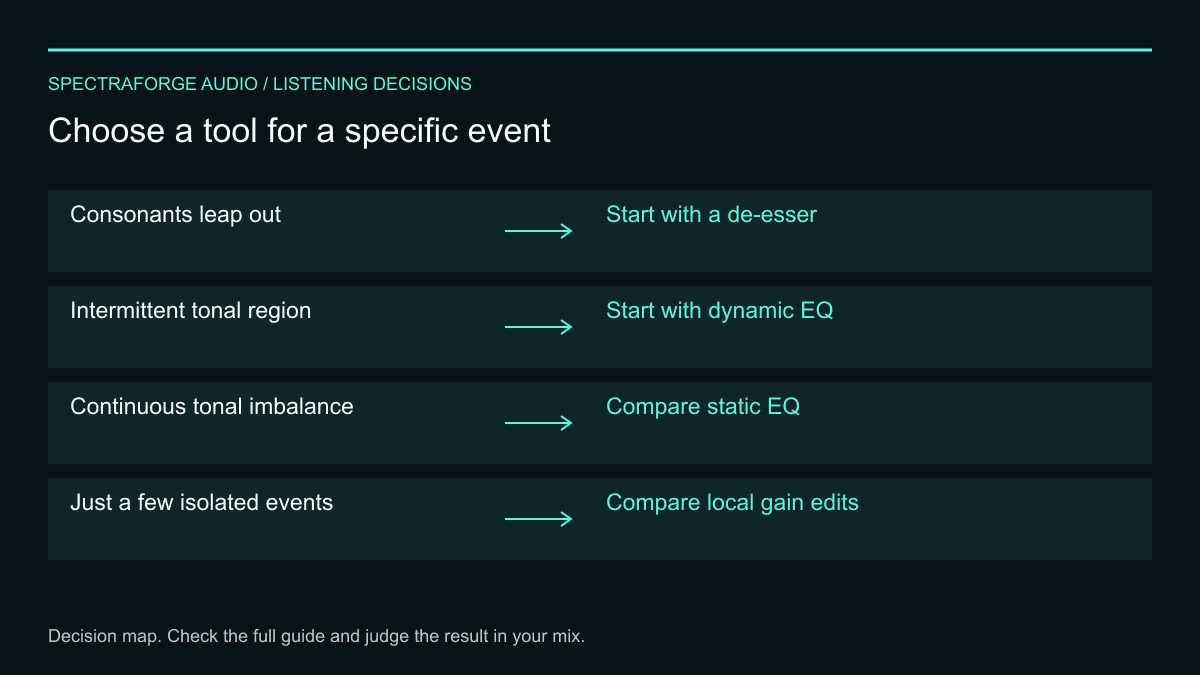
Choose by the event you want to reduce
The categories overlap: a de-esser can use frequency-based detection, while a dynamic EQ can target a broad high band. The useful distinction is the trigger, processed bandwidth, and timing available in the particular tool. Pro-DS, for example, offers vocal-focused and general detection; Pro-Q 4's dynamic bands respond to a configurable level-dependent trigger.
| What you hear | First move | Check |
|---|---|---|
| Consonants leap out | Start with a de-esser | Check detection and the complete word |
| Intermittent tonal region | Start with dynamic EQ | Check the band, trigger and release |
| Continuous tonal imbalance | Compare static EQ | Check whether less upstream enhancement helps |
| Just a few isolated events | Compare local gain edits | Check continuity across each edit |
Compare the two on a deliberately difficult phrase
Use a vocal line with a long loud vowel followed by a sharp s. On one version, set a de-esser to act mainly on the consonant. On another, set a dynamic bell around the vowel's objectionable region. Match output levels and switch between versions. The exercise separates two issues that may sound like one general complaint of harshness.
If the dynamic bell softens the vowel but barely catches the s, it has not failed; it is solving the target you gave it. If the de-esser catches both and takes too much life from the vowel, refine its detection or reduce its range. You may need two light treatments, but keep them only if each has a clearly audible job.
Set detection before increasing reduction
Audition the detector when available. In some tools, detection and processed bandwidth differ, or an external signal triggers the band. Check those controls instead of assuming the visible EQ curve describes both jobs.
Begin with a modest maximum reduction. Adjust detection to catch the difficult event, then listen to how the process releases into the next syllable. If a word's tone changes halfway through, or the high end pumps between accents, reduce the range or refine timing. Adjust timing only where the processor exposes it; automatic modes may determine it from the signal.
Choose the shape of the audible change
A dynamic bell can target a local region; a dynamic shelf can change a broader area. A de-esser may offer wide-band or split-band processing. These choices produce different transitions during a consonant. A whole-signal dip may preserve the consonant's spectral shape but alter its level; a high-band dip keeps lower content steadier but can alter brightness.
Try the modes at similar apparent strength on the same passage. Do not copy a numerical threshold or range from one algorithm to another and assume an equivalent result. Check the entire word, including the sound immediately before and after the trigger. For vocals, clarity of pronunciation is usually a more useful comparison than an isolated high-frequency solo.
Keep two tools only when they solve two problems
On a vocal with a hard vowel and a separate sharp esse, two light treatments may be useful. On a consistently bright recording, one shelf or less upstream enhancement may be enough. On two isolated esses, local gain edits can spare the rest of the song from detection errors.
Check quiet and loud phrases inside the mix. If you are adding reduction because the voice is difficult to hear, first lower the competing instrument or ride the phrase; neither dynamic EQ nor a de-esser solves a quiet vocal by removing more of it.
Technical references
Listening exercises are proposed practice routines. Worked examples illustrate the stated setup; they are not reports of our listening tests. Editorial process and corrections.