
Silk tutorials
Add air without harshness: a Silk listening workflow
Use a drum-submix comparison to decide whether Silk adds useful openness, exposes a source problem, or leaves the original balance as the better choice.
Add air when a balanced source needs a more open high-frequency character. If a vocal only disappears on certain words, try a level ride or reduce the competing sound first. If the unprocessed recording already has painful esses or splashy cymbals, repair that problem before asking an enhancer to finish it.
By Spectraforge Audio3 min read
Published · Updated
Guide review: Captum Records and AS Mastering. AI-assisted writing and source checks. How these guides are made.
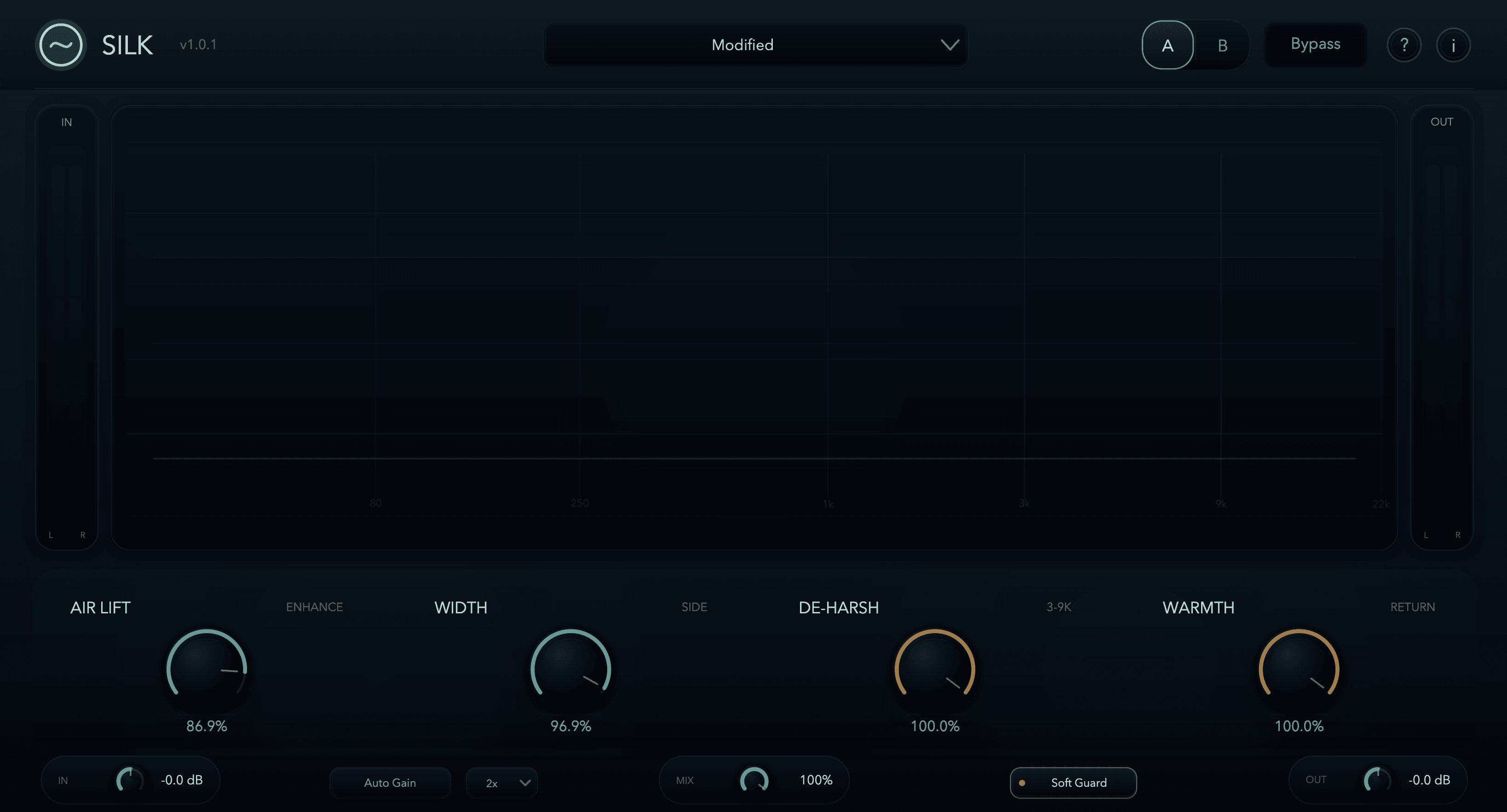
Decide whether enhancement solves the problem
For this proposed exercise, choose a drum submix that contains a restrained verse groove and a busier fill or chorus. Listen with the bass and lead present. Write down the need before adding Silk: for example, the hats feel recessed while the snare and cymbal balance already works. If you cannot identify a useful tonal change, keep the source as it is.
| What you hear | First move | Check |
|---|---|---|
| Balanced source feels closed | Try a small Air Lift | Compare in the mix at matched level |
| Harsh before Silk | Repair the source first | Check the offending track or effect return |
| Only the added lift is edgy | Reduce Air Lift; compare De-Harsh | Check your engine version in the manual |
| Only the busy section suffers | Use less or a section-specific move | Recheck sparse and dense passages |
Test a small lift across sparse and busy passages
Start with Width and Warmth neutral, turn on Auto Gain, and add a small Air Lift. Auto Gain uses K-weighted measurement to help compare perceived level; play the same passage before judging Bypass and check any remaining level difference. Set Output separately when a final level matters.
Compare both sections at normal and quieter monitoring levels. Accept the lift if the hats become easier to follow and the snare still has its body. If only the sparse groove improves, consider a section-specific move. If the busy passage turns into cymbal wash, reduce the lift or return to the individual tracks rather than compensating for every problem on the bus.
Separate a source fault from the finishing move
If the fill is harsh with Silk bypassed, inspect the offending cymbal, microphone balance or effect return first. If only the added lift is edgy, compare a smaller lift and version-appropriate De-Harsh. Judge the complete kit: taming a cymbal at the expense of the snare may be the wrong bus decision.
Check the Information panel and manual for your engine. Earlier 1.0.2 De-Harsh controls added enhancement; Silk 1.1.0 can also cut original content in the wet signal. Both need Air Lift. Warmth also differs by version, so it is not a universal remedy for a thin kit. Use the detailed control reference before adding another move.
Accept the change only after mono and output checks
Compare a proper mono sum with the dry kit too. Width adjusts existing side information; 0% is neutral and mono sources gain no new stereo information. Reducing Width cannot reconstruct a side-only sound in mono. Investigate the source when the same detail disappears in bypass, and the tone/gain path when the loss appears only with Silk.
Choose Quality before the final comparison and render: 2x is default, while 4x costs more CPU and latency. Auto Gain is not a limiter. Soft Guard sits before Mix, Auto Gain and Output, so it is not a final peak ceiling. Check the rendered output in your DAW. Use raw Bypass for the comparison; Mix 0% still allows Input, Auto Gain and Output to change level.
A change that fails these checks does not need to stay. Save the original setting and project. Before replacing an engine, render important tracks and keep its installer plus a private backup of the working signed licence file; there is no legacy switch and a new licence may not unlock an older build. Archive audio has unrecorded builds/settings, and the screenshot shows 1.0.1; neither demonstrates the 1.1 engine.
Technical references
Listening exercises are proposed practice routines. Worked examples illustrate the stated setup; they are not reports of our listening tests. Editorial process and corrections.
Silk control reference · Raw and processed listening examples